A product-led SEO case study on moving beyond rankings and into measurable ecommerce growth
Executive Summary
When most skincare brands talk about SEO, the conversation tends to revolve around two things: keyword rankings and traffic volume. Useful metrics, but rarely the ones that pay the bills.
Ad Crowd took a different position with Jenpharm. We treated organic search as an acquisition channel that had to be accountable to revenue, purchasers, and new-customer growth — not just impressions on a dashboard.
Over the measured period, the program produced:
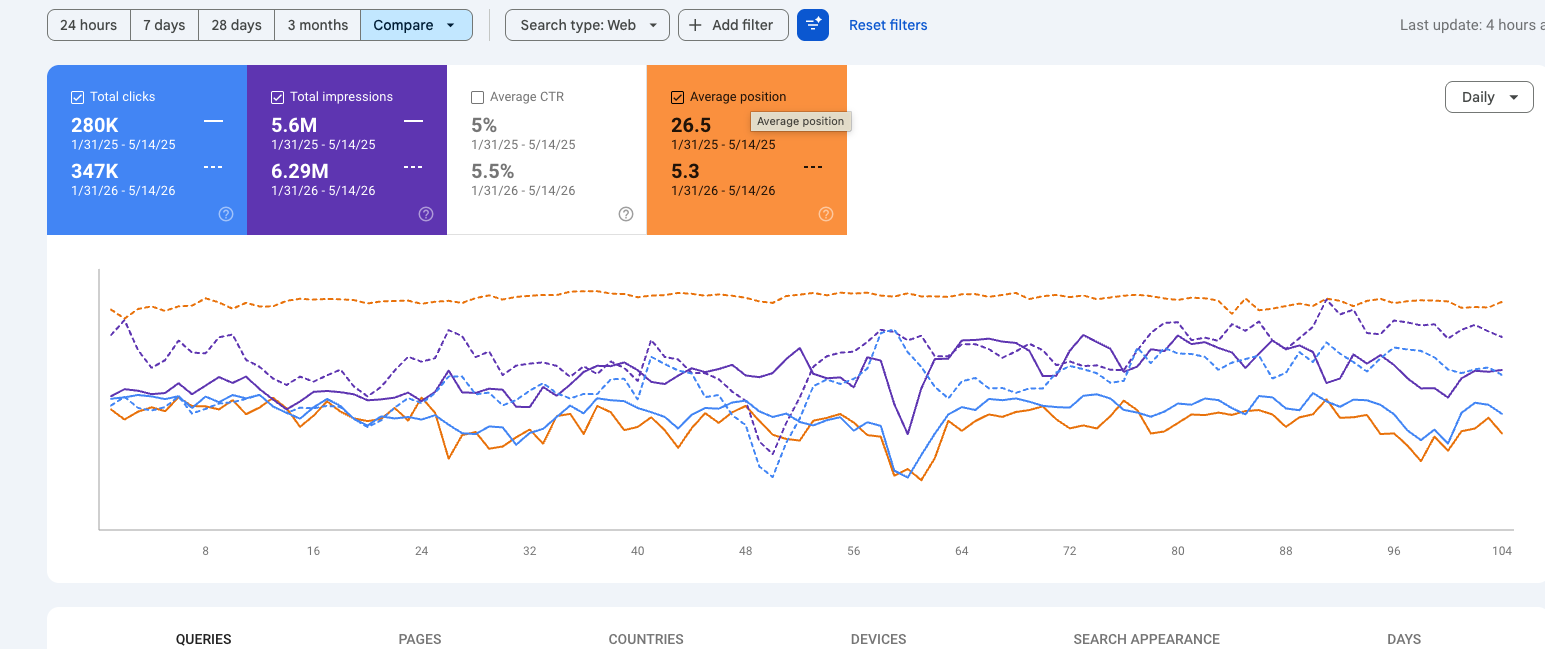
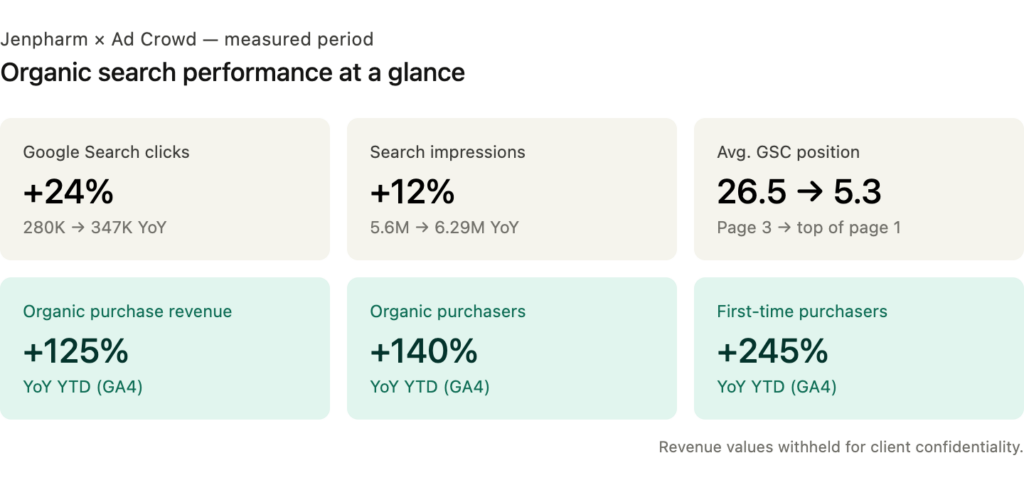
- ~24% YoY growth in Google Search clicks (280K → 347K)
- ~12% YoY growth in impressions (5.6M → 6.29M)
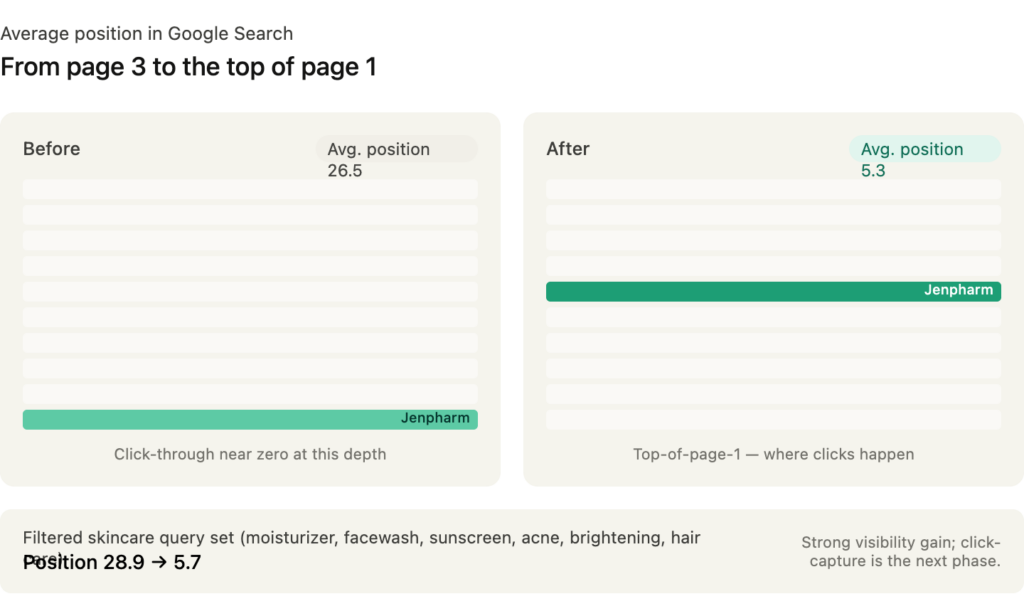
- Average GSC position improving from 26.5 to 5.3
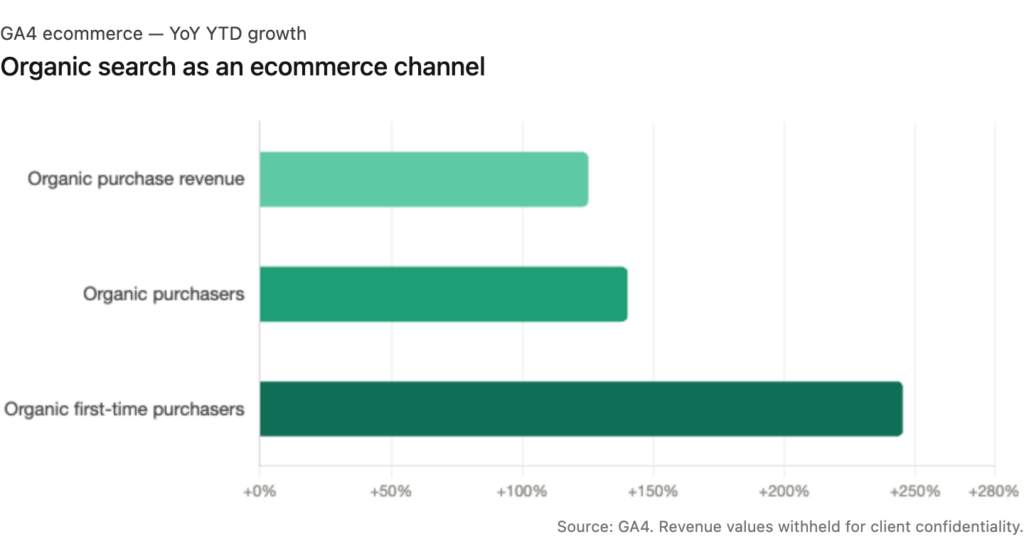
- +125% YoY YTD in GA4 organic-attributed purchase revenue
- +140% YoY YTD in organic purchasers
- +245% YoY YTD in organic first-time purchasers
- More than half of tracked purchase revenue during the measured period attributed to organic search
Revenue values are not disclosed for client confidentiality.
Client Background
Jenpharm is a Pakistan-based derma skincare brand with a deep portfolio across moisturizers, sunblocks, facewashes, brightening products, and a growing hair care line under the Anagrow label. Products like Dermive, MandelAC, Maxdif, Spectra Block, and Anagrow have steady demand from skincare-conscious buyers searching online — often with strong purchase intent, often by exact product name.
That intent was the opportunity. The question was whether the website was set up to capture it.
The Challenge
Jenpharm was already getting organic traffic when we started. The brand had recognition, the products had demand, and Google was sending visitors. The deeper issue was that organic search was not behaving like a real ecommerce channel.
A few specific gaps stood out:
- Strong commercial keywords (product names, “price in pakistan” queries, ingredient-led terms) were ranking on page 2 and 3, where click-through collapses. Demand was being created somewhere else, then lost at the SERP.
- Product and category pages were under-optimized for the exact way customers searched — by brand name, by product name, by problem (“hair fall,” “acne,” “brightening”), and by price intent.
- The site had technical and internal linking issues that diluted authority across hundreds of product URLs.
- There was no clean way to attribute organic search to actual purchase behavior, so the team couldn’t see whether SEO was producing customers or just sessions.
The brief, as we framed it internally, was simple: stop optimizing for visibility alone, and start optimizing for purchasers.
The Strategy
We built the program around five principles. None of them are exotic, but the discipline of running them together is where most ecommerce SEO programs fall apart.
1. Product-led SEO
Instead of starting with blog topics, we started with the product catalog. Every SKU got mapped to the queries that already had purchase intent attached — product name, brand + product, “price in pakistan” variations, problem-led (“hair fall shampoo,” “oil free moisturizer,” “matt sunblock”), and ingredient-led (“mandelic acid face wash”).
2. Commercial keyword mapping
We segmented keywords by intent — informational, navigational, transactional — and built a coverage plan that prioritized transactional and bottom-of-funnel terms first. These are the queries where a ranking improvement converts directly into revenue rather than just sessions.
Examples of priority commercial queries we targeted:
- anagrow shampoo price in pakistan
- anagrow shampoo
- dermive moisturizer
- mandelac face wash price in pakistan
- jenpharm sunblock
- mandelac face wash
- dermive moisturizer price in pakistan
- dermive oil free moisturizer
- maxdif face wash price in pakistan
- spectra matt sunblock price in pakistan
- anagrow hair serum
- dermive face wash
- mandelic acid face wash
- dermive sensitive moisturizer
3. Product and category page optimization
We rewrote and restructured key product detail pages and category pages so they actually matched search intent — proper H1s, clear product naming, benefits framed the way customers describe their problems, structured content blocks, schema, and clean image and metadata implementation.
4. Search intent alignment
Not every query deserves the same template. A “price in pakistan” query needs a product page with the price visible. A “mandelic acid face wash” query needs an ingredient-led product page. A “hair fall” query may need a category-level entry point. We mapped page types to intent types instead of forcing one format across the catalog.
5. Technical SEO cleanup and internal linking
Crawl issues, indexation waste, weak internal links between related products and categories — these were the invisible drag on the site’s authority. We worked through them in the background while the on-page and content work compounded.
Execution Areas
In practice, the work broke down across these workstreams:
- Keyword research at the SKU level for the full active catalog, prioritized by commercial value
- On-page optimization for product detail pages and category pages
- Search-intent-matched copy for category and collection pages (sunblocks, moisturizers, hair care, brightening)
- Schema and metadata improvements across product templates
- Internal linking architecture connecting category → subcategory → product, and related products to each other
- Technical SEO cleanup covering crawl, indexation, and site hygiene
- Ongoing reporting against GA4 ecommerce events rather than just GSC vanity metrics
Results
Search Console performance (YoY)
GA4 ecommerce performance (YoY YTD)
Latest 90 days vs. first active 90 days
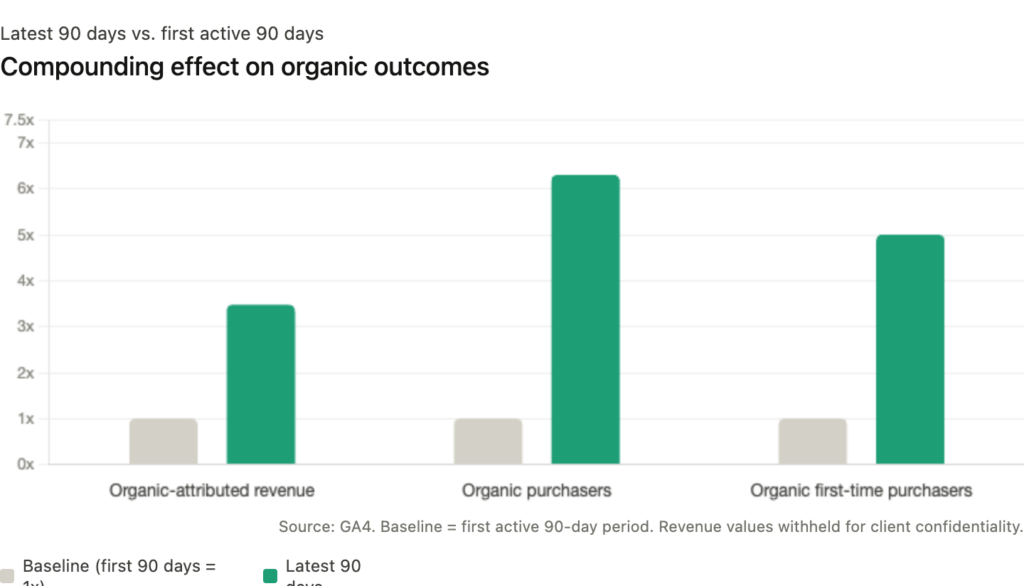
| Metric | Multiplier |
|---|---|
| Organic-attributed purchase revenue | 3.48x |
| Organic purchasers | 6.31x |
| Organic first-time purchasers | 5.01x |
Channel contribution
During the measured period, organic search contributed more than half of tracked purchase revenue in GA4 — making it the single largest channel for purchaser acquisition in the period.
Skincare query visibility
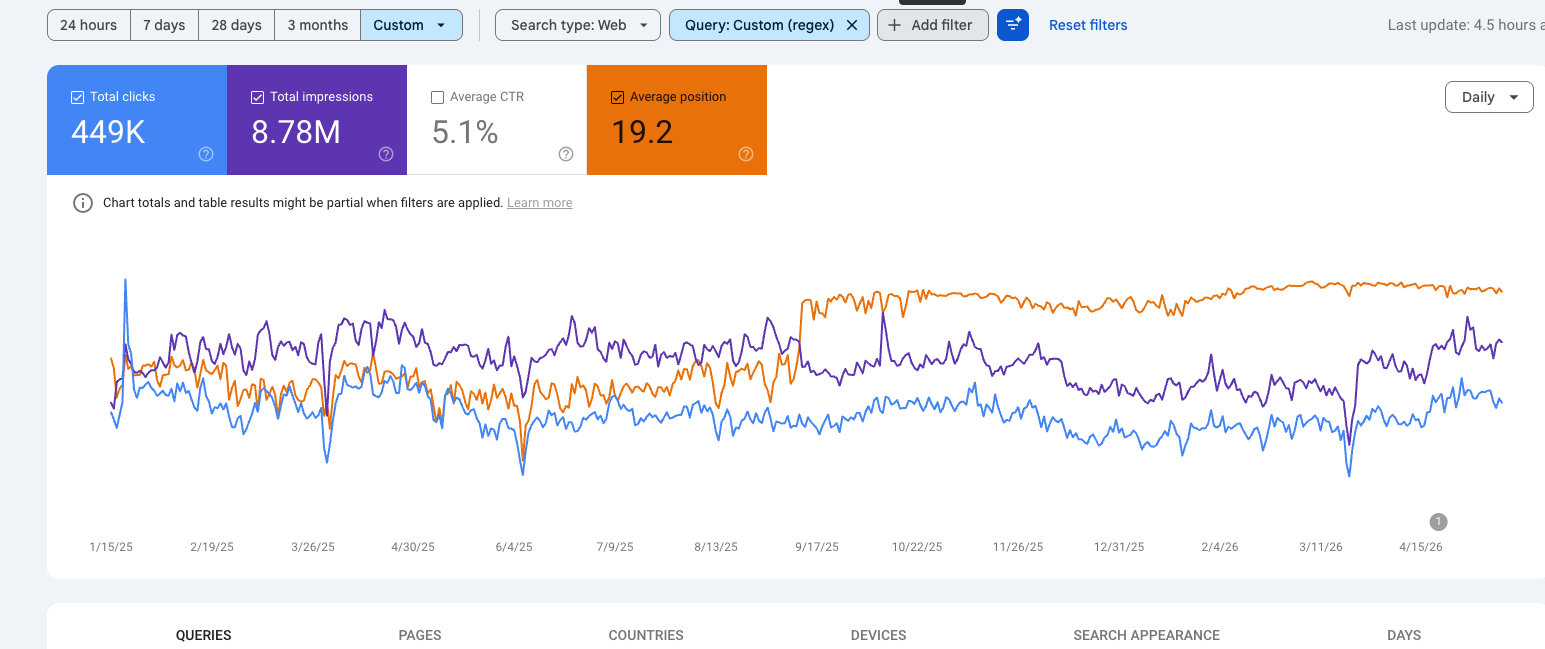
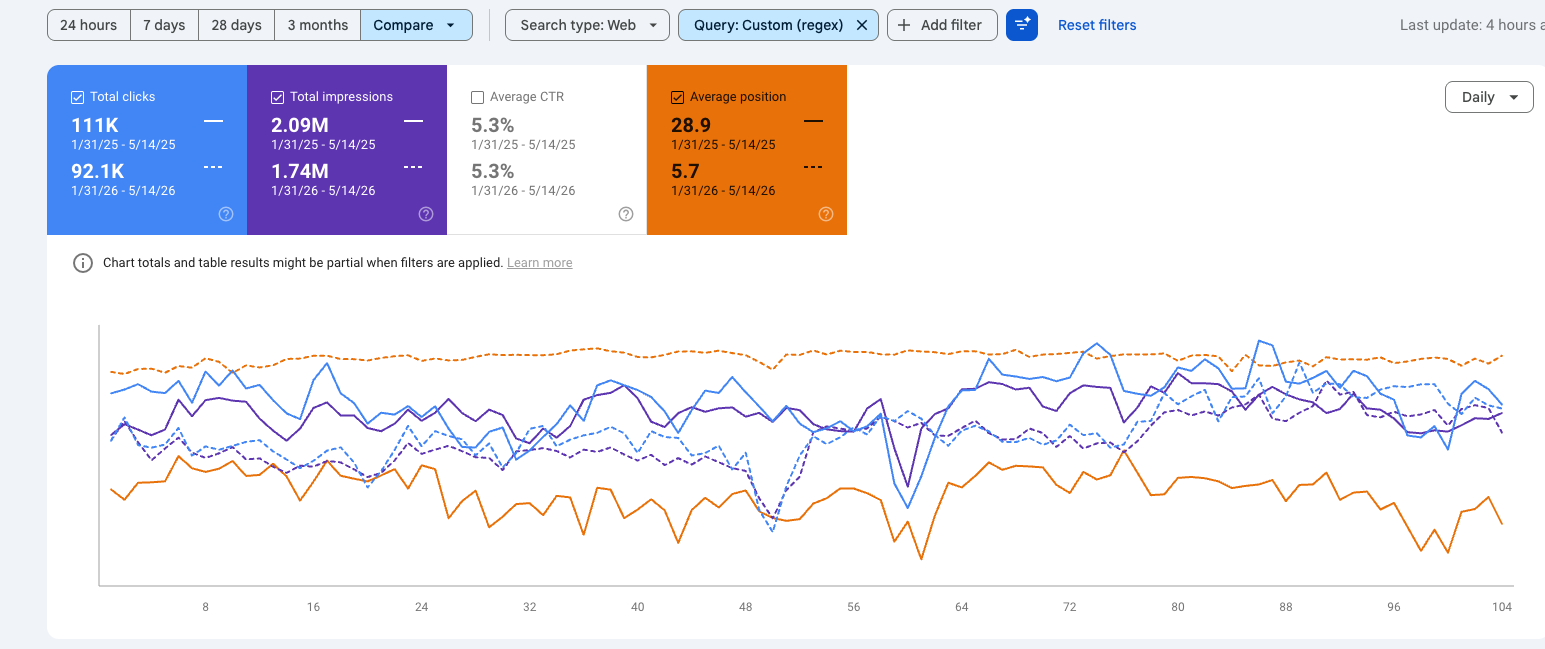
A filtered GSC export across selected skincare query themes — moisturizer, facewash, sunscreen, acne, brightening, hair serum, shampoo, hair fall, and hair growth terms — showed average position improving from 28.9 to 5.7.
An important nuance: within that filtered query set, clicks and impressions were down approximately 17% each, even though rankings improved sharply. We’re reading this as a visibility gain that hasn’t been fully monetized yet — a click-capture opportunity for the next phase, where title tag, meta description, and SERP-feature optimization should pull through the conversion the rankings have earned.
Pages organic traffic actually reached
Rankings only matter if they land on the pages that sell. Organic visitors reached, among others:
- Anagrow Anti Hair Fall Shampoo
- Dermive Oil Free
- MandelAC Facewash
- Sun Protection collection
- Spectra Block Sunblock
- Maxdif Skin Brightening Facewash
- Spectra Matt
- Anagrow Hair Serum
- Spectra Block Max 100
- Dermive Sensitive Moisturizer
Top organic-selling products (GA4)
The products converting through organic during the measured period span the brand’s full range:
Dermive Oil Free Moisturizer · MandelAC Facewash · Maxdif Facewash · Spectra Block Max 100 · Anagrow Shampoo · Maxdif Brightening Cream · Dermive Sensitive Moisturizer · Anagrow Hair Serum · Brightening Coffee Soap · Maxdif Brightening Serum · MandelAC Serum · NiaRonic Serum · Skin Rescue Mist.
This breadth matters. The growth isn’t concentrated in one hero SKU — it’s distributed across the catalog, which is the healthier shape for a long-term SEO program.
Business Impact
Stepping back from the dashboards, here is what the program actually shifted:
Organic search became a measurable acquisition channel. Before, SEO was producing traffic. Now it’s producing tracked purchasers, with GA4-attributed numbers the leadership team can actually plan against.
First-time buyer acquisition compounded faster than total revenue. First-time purchasers grew +245% YoY YTD against +125% revenue growth, which tells us organic isn’t just monetizing existing demand — it’s bringing in new customers who hadn’t bought before. That’s the leading indicator for next year’s repeat revenue.
Commercial intent queries moved to where they convert. With average position moving from 26.5 to 5.3, the catalog is now visible on the part of the SERP where clicks actually happen. Page-3 rankings convert at near-zero. Top-of-page-1 rankings carry weight.
The program created a visibility surplus. The skincare query set’s filtered rankings improved from 28.9 to 5.7 without proportional clicks yet. That gap is a roadmap — it tells us where future click-capture work (titles, meta, snippets, SERP features) will produce the next leg of growth.
We want to be careful here: organic search did not single-handedly drive all of Jenpharm’s revenue growth, and we’re not claiming that. What we can say is that SEO contributed meaningfully to ecommerce growth, and the contribution is visible in clean GA4 numbers rather than inferred.
What This Means for Ecommerce Brands
A few takeaways we’d offer to any ecommerce brand looking at their SEO program:
Rankings are a means, not the result. A ranking that lands on a weak product page is wasted. A ranking on a page built to convert is revenue. Optimize the page before you celebrate the position.
Product-led SEO outperforms blog-led SEO for ecommerce. Editorial content has its place, but for skincare, supplements, and similar ecommerce categories, the highest-intent queries are commercial — brand names, product names, “price in,” ingredient queries. That’s where the spend should go first.
Attribution should be ecommerce-native. GSC tells you what’s ranking. GA4 tells you what’s selling. A serious SEO program reports on both, and the second one is the one that matters to the board.
Visibility and clicks can move at different speeds. When rankings improve faster than clicks, that’s not a failure — it’s a queue. The conversion just hasn’t been pulled through yet, and that’s a problem with a known solution.
New-customer growth is the leading indicator. If first-time buyers are growing faster than total revenue, the program is healthy. If the opposite is true, the channel is leaning on returning customers and will stall.
Work With Ad Crowd
If your ecommerce brand is getting organic traffic but can’t see whether SEO is producing actual customers, that’s the gap we close. We build product-led SEO programs designed to be accountable to GA4 — not just to a rankings tracker.
The Jenpharm program is one of several we’ve run with this approach. We’d be happy to walk you through what it would look like for your catalog.
Get in touch with Ad Crowd to scope an ecommerce SEO program built for revenue, not just rankings.
GSC Data to Support our Case Study